Analysis
We were interested in seeing if any shift occurred during these two centuries. Thus, we counted the number of people per quarter and per arrondissement for both years, and normalized the results by the total number of famous people of that particular year. We then output two related graphs.
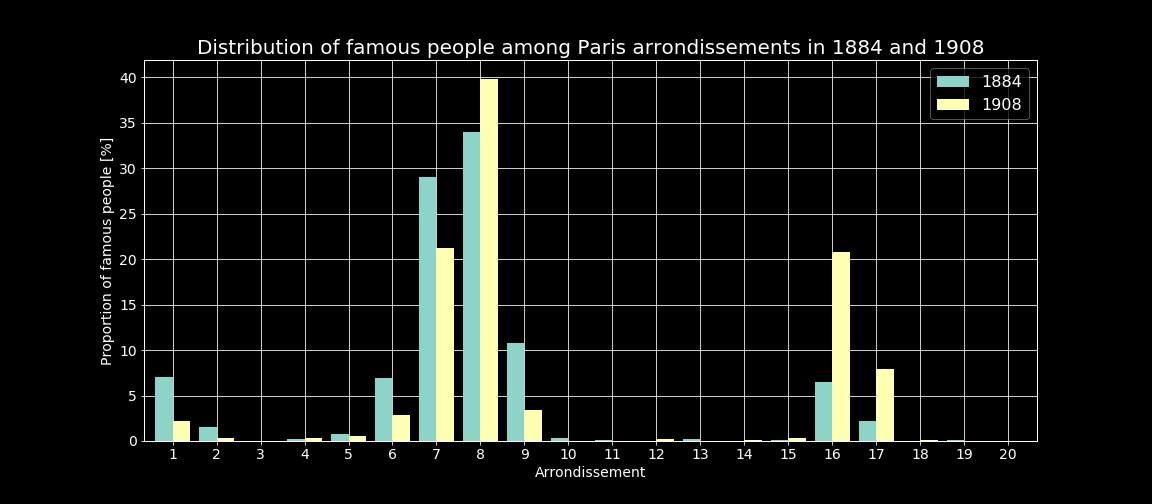
Here we can see something interesting. Indeed, as it was already observed on the maps, in 1884 the famous people seem to be clustered in a few arrondissements, namely the 7th and the 8th. This is not surprising, as still today those are the richest and fanciest arrondissements of Paris, with the Champs-Elysées or Place de la Concorde. What is however more interesting is the shift that can be observed in 1908. It seems that the famous people left the 1st, the 6th, the 7th and the 9th arrondissements moving towards the 16th and the 17th, situated outside the center of Paris. Notably, the 16th arrondissement, Passy, had been annexed to Paris only in 1860, due to Paris expansion with the June 16th 1859 law. With the opening of the first subway lines in 1900, moving around in the city was much easier and this might have encouraged famous people to move towards the border of the city.
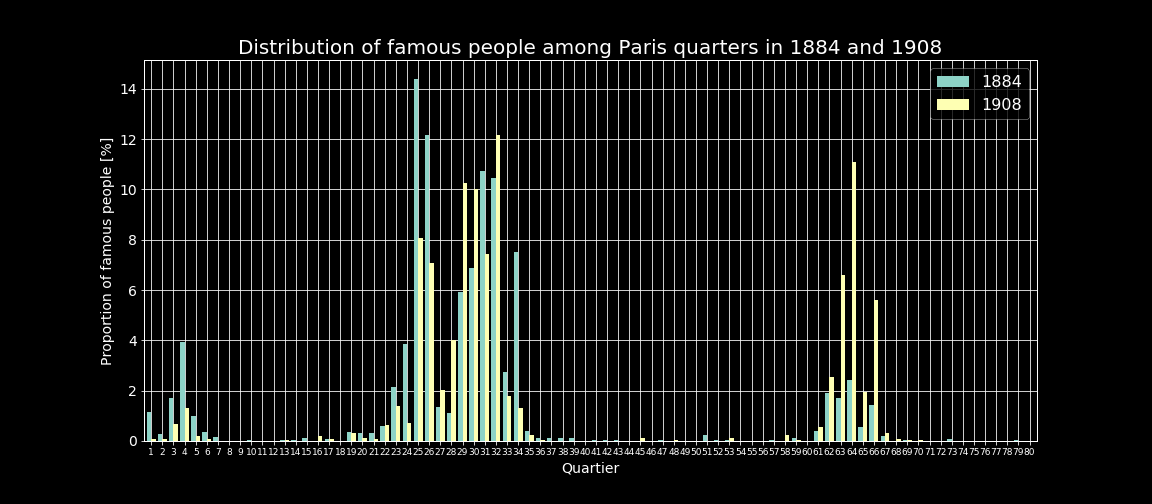
With this second graph we can observe more in detail the repartition of famous people in Paris and the shift between the two periods. Using the 1908 map, we can notice that the quarters populated with the most famous people are the ones where the already functioning subway lines are passing. Particularly central seems to be Place de l'Etoile, where multiple important streets and subway lines cross, at the corner between the 29th, the 30th, the 64th and the 65th (four among the most "famously" populated quarters of Paris).
Further analysis could focus on specific subway stations but more data would be needed in order to obtain significant results.